
What Are Thermoplastic Additives Example Uses and Advantages
Thermoplastic materials play a crucial role in modern manufacturing thanks to their recyclability, durability, and contribution to long-term sustainability. They can be melted, reshaped, and reused multiple times without significant degradation, making them ideal for eco-friendly production. In this article, Evergreen chemical supplier in Thailand explore the thermoplastic additives commonly used to create and enhance thermoplastic polymers.
Find Our Chemical Products
What Are Thermoplastic Polymers
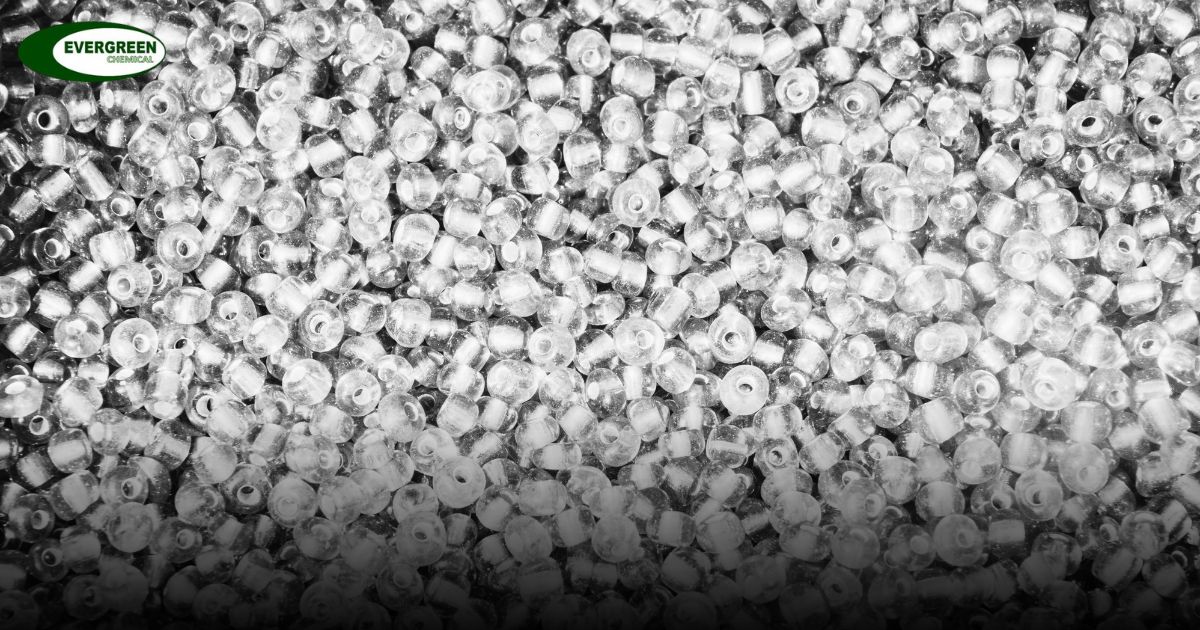
Thermoplastic polymers are long-chain molecules composed of repeating monomers connected by covalent bonds. Their defining chemical property is their ability to soften when heated and solidify when cooled without undergoing permanent chemical change. This reversible physical transition makes thermoplastics recyclable and easy to process in various molding and extrusion applications.
Common examples of thermoplastic polymers include:
- Polyethylene (PE): packaging, films, bags
- Polypropylene (PP): automotive parts, storage containers, woven fabrics
- Polyvinyl Chloride (PVC): pipes, cables, profiles
- Polystyrene (PS): food packaging, insulation materials
These materials often rely on additives for stability, flexibility, and long-term performance.
The Thermoplastic Additives
Polymers alone may not possess all the properties required for end-use performance. Thermoplastic additives are incorporated to improve thermal stability, mechanical strength, and processing efficiency. In many formulations, a plasticizer is also used to enhance flexibility, reduce brittleness, and improve workability during manufacturing. Common stabilizers used in thermoplastic systems include:
Organotin Stabilizer
Organotin stabilizers are organometallic compounds containing tin bonded to organic groups, widely used for PVC thermal stabilization during high-temperature processing.
| Advantages | Disadvantages |
| Excellent heat resistance | Toxicity concerns in certain applications |
| High clarity and minimal impact on product appearance | Higher cost compared to alternative stabilizers |
| Effective even at low concentrations | – |
Calcium Zinc Stabilizer
Calcium zinc stabilizers are non-toxic heat stabilizers that neutralize hydrochloric acid released during PVC degradation. They are widely used as an eco-friendly replacement for lead stabilizers. In some polymer-processing systems, auxiliary lubricating agents like magnesium stearate may also be incorporated to improve melt flow and reduce friction during extrusion.
| Advantages | Disadvantages |
| Environmentally friendly and suitable for food-contact applications | May require higher loading levels to achieve long-term heat resistance |
| Good heat stability for flexible and rigid PVC | Slightly less efficient compared to lead stabilizers at extreme processing temperatures |
| Safe and compliant with global regulations | – |
Lead Stabilizer
Lead stabilizers have been traditionally used for PVC due to their strong heat-stabilizing performance and long-term durability.
| Advantages | Disadvantages |
| Excellent long-term thermal stability | Environmental and health concerns |
| Highly effective for a range of rigid PVC applications | Increasingly restricted or banned in many countries |
| Cost-effective | – |
Conclusion
Thermoplastic polymers are essential in modern applications due to their recyclability, durability, and versatility. To achieve optimal performance, they rely on a range of thermoplastic additives, including organotin, calcium zinc, and lead stabilizers. These additives help ensure thermal stability, processing efficiency, and material reliability making thermoplastics a key component in sustainable, high-performance manufacturing.