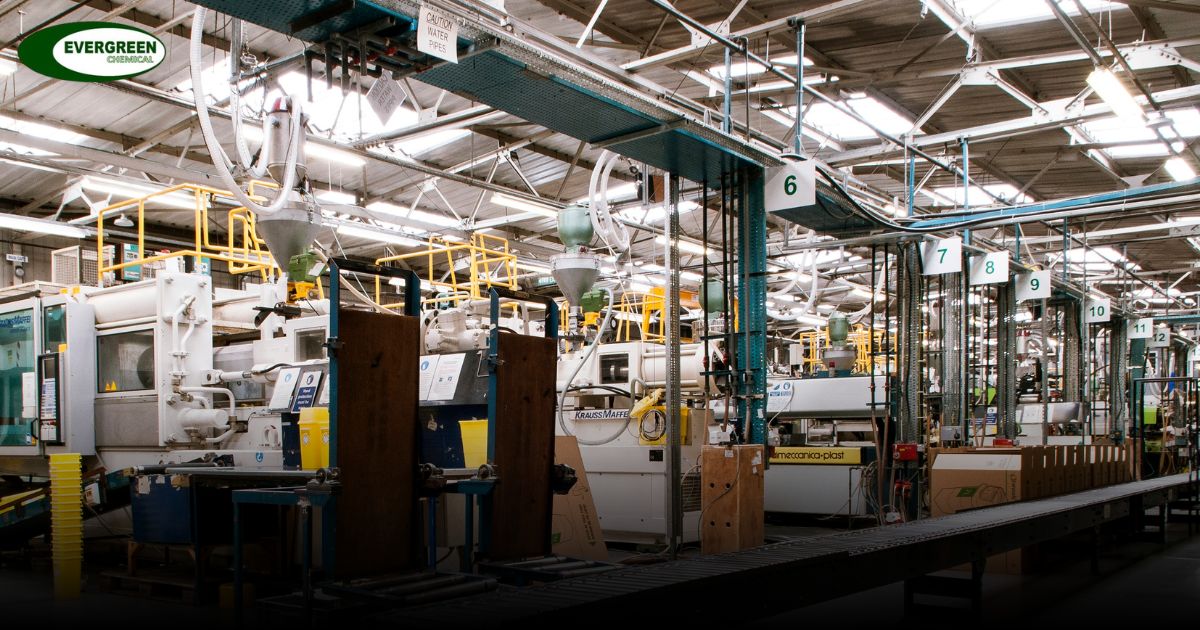
Plastic Manufacturing Process Complete Guide for Industry
Plastic has become one of the most essential materials in modern civilization. From medical devices and food packaging to automotive components and consumer electronics, plastic manufacturing supports nearly every industrial sector worldwide. The global plastic manufacturing industry produces over 400 million metric tons of plastic annually, according to industry reports, reflecting its indispensable role in global supply chains.
But how exactly are plastics made? What happens behind the scenes in a factory? And what materials and additives are used to enhance performance? This article provides a comprehensive explanation of the plastic manufacturing process, breaking down each major production method and exploring different plastic types used in everyday life.
Find Our Chemical Products
Plastic Manufacturing Process
The plastic manufacturing process involves transforming raw polymer resins into finished products through various molding and shaping techniques. Each method serves specific product requirements, production volumes, and material characteristics.
1. Injection Molding
Injection molding is one of the most widely used techniques in the plastic manufacturing industry due to its precision, repeatability, and suitability for mass production. It is especially ideal for producing complex parts with tight tolerances and detailed geometries.
This process is highly automated, making it efficient for high-volume production runs. Modern injection molding machines are equipped with advanced control systems that monitor temperature, pressure, and injection speed to ensure consistent quality. Multi-cavity molds can produce several identical parts in one cycle, reducing unit cost and increasing productivity. Injection molding supports a wide range of thermoplastics and engineering polymers, including reinforced materials such as glass-filled plastics. It also enables overmolding and insert molding, where metal components or multiple plastic materials are combined into a single finished product.
Process Overview:
- Plastic pellets are fed into a heated barrel.
- The material melts under high temperature.
- Molten plastic is injected into a mold cavity.
- The part cools and solidifies.
- The mold opens and ejects the finished product.
Common Additives Used:
- Plasticizers for flexibility
- Stabilizers to improve heat resistance
- Lubricants like Calcium Stearate to enhance flow and mold release
- Performance enhancers such as plastic additive solutions for UV or flame resistance
Applications include:
- Automotive parts
- Medical components
- Electronic housings
- Consumer goods
2. Blow Molding
Blow molding is primarily used to create hollow plastic parts such as bottles and tanks. It is highly efficient for manufacturing lightweight containers in large volumes.
There are several types of blow molding processes, including extrusion blow molding, injection blow molding, and stretch blow molding. Each variation is selected based on product requirements such as wall thickness control, clarity, and mechanical strength. This method offers cost efficiency for high-speed production and is widely used in the packaging, automotive, and consumer goods industries. Advanced blow molding technologies allow precise control over material distribution, improving strength and reducing material waste.
Process Overview:
- Plastic is melted and formed into a tube (parison).
- Air is blown into the tube inside a mold.
- The plastic expands to match the mold shape.
- Cooling completes the product.
Common Additives Used:
- Impact modifiers
- UV stabilizers
- Processing aids such as Zinc Stearate for improved surface finish
Applications include:
- Bottles
- Fuel tanks
- Containers
3. Extrusion
Extrusion produces continuous plastic shapes with a fixed cross-sectional profile. It is one of the most cost-effective manufacturing processes for producing long products in large quantities.
The extrusion process allows manufacturers to produce consistent profiles such as pipes, sheets, films, and cables. Co-extrusion technology can combine multiple layers of materials to enhance product performance, such as adding barrier layers or improving mechanical strength. Extrusion systems are highly customizable and can process a wide variety of thermoplastics. The process offers excellent scalability and is commonly integrated into automated downstream systems for cutting, cooling, or shaping.
Process Overview:
- Plastic pellets are melted.
- The molten plastic is pushed through a die.
- The shaped material cools and solidifies.
Common Additives Used:
- Heat stabilizers
- Slip agents
- Lubricants like Magnesium Stearate
- Fillers sourced from a trusted chemical supplier in thailand
Applications include:
- Pipes
- Window frames
- Sheets
- Cables
4. Rotation Molding (Rotational Molding)
Rotation molding creates large, hollow, seamless products with uniform wall thickness. It is especially suitable for producing durable, stress-free parts without weld lines.
Unlike other molding processes, rotational molding does not involve high pressure. This reduces mold cost and makes it ideal for producing large components with complex shapes. The process is relatively slower but offers excellent design flexibility. It is commonly used for outdoor and industrial applications due to its ability to produce thick, durable walls and long-lasting products.
Process Overview:
- Plastic powder is placed in a mold.
- The mold rotates while being heated.
- The material coats the interior evenly.
- Cooling solidifies the shape.
Common Additives Used:
- UV stabilizers
- Color pigments
- Flow modifiers to ensure uniform wall thickness
Applications include:
- Water tanks
- Outdoor furniture
- Industrial containers
5. Thermoforming
Thermoforming is commonly used for packaging and disposable products due to its speed and cost efficiency. It is particularly suitable for thin plastic sheets and large surface-area items.
The process is divided into vacuum forming, pressure forming, and mechanical forming, depending on the complexity and detail required. Thermoforming has relatively low tooling costs compared to injection molding, making it ideal for medium-volume production. It supports various materials such as PET, PVC, PS, and PP, especially for food-grade packaging applications.
Process Overview:
- A plastic sheet is heated.
- It becomes pliable.
- Vacuum or pressure forms it into a mold.
- Excess material is trimmed.
Common Additives Used:
- Impact modifiers
- Clarity enhancers
- Anti-static agents
Applications include:
- Food packaging
- Blister packs
- Disposable trays
Different Types of Plastic
Understanding plastic types is essential in selecting the right material in the plastic manufacturing industry. Each plastic category offers unique mechanical properties, chemical resistance, temperature tolerance, and processing characteristics. Material selection affects durability, cost efficiency, sustainability, and compliance with industry standards. Engineers consider factors such as tensile strength, flexibility, environmental exposure, and recyclability when choosing the appropriate plastic type.
1. Thermoplastics
Thermoplastics can be melted and reshaped multiple times without significantly altering their chemical structure. This makes them highly versatile and recyclable. They soften when heated and harden when cooled, allowing repeated processing. Thermoplastics dominate the plastic manufacturing industry because of their ease of processing and wide range of applications.
Advantages:
- Recyclable
- Cost-effective
- Flexible processing
Disadvantages:
- Lower heat resistance
Common Uses:
- Packaging
- Bottles
- Automotive parts
Examples: Polyethylene (PE), Polypropylene (PP), PVC
2. Thermosetting Plastics
Thermosets permanently harden after curing through a chemical reaction. Once set, they cannot be remodelled or reshaped. They offer superior structural integrity, high temperature resistance, and excellent chemical resistance. Thermosets are commonly used in demanding industrial and electrical applications.
Advantages:
- High heat resistance
- Strong mechanical properties
Disadvantages:
- Cannot be remelted
Common Uses:
- Electrical insulation
- Adhesives
- Automotive components
3. Biodegradable Plastics
Biodegradable plastics are designed to break down naturally under specific environmental conditions such as composting environments. They are increasingly used as sustainable alternatives to conventional plastics in response to environmental concerns. These materials are often derived from renewable resources such as corn starch or sugarcane. While environmentally friendly, their mechanical strength and durability may be lower compared to conventional plastics, depending on formulation.
Advantages:
- Environmentally friendly
- Reduced carbon footprint
Disadvantages:
- Higher production cost
- Limited durability
Common Uses:
- Compostable packaging
- Agricultural films
4. Elastomers
Elastomers are rubber-like materials with high elasticity and flexibility. They can stretch significantly and return to their original shape without permanent deformation. These materials are widely used in applications requiring shock absorption, sealing, and flexibility. Elastomers can be thermoplastic (TPE) or thermoset-based (rubber compounds).
Advantages:
- Flexible
- Durable
Common Uses:
- Seals
- Gaskets
- Footwear
- Medical tubing
FAQ – Plastic Manufacturing Industry
Conclusion
The plastic manufacturing industry remains one of the most vital pillars of global production. Understanding the plastic manufacturing process from injection molding to thermoforming helps businesses choose the right method and materials for optimal performance. As sustainability, innovation, and material science evolve, plastic manufacturing continues to adapt with advanced additives, eco-friendly polymers, and smart processing technologies.